OVERVIEW
“What a wonderful light airy space” is a comment frequently heard when visitors first enter the large church building in Waddesdon. The spaces we occupy, be that our homes or the public domain, affect how we live in them and use them. St. Michael and All Angels is unusually large for a village church and offers many opportunities for the local community to find different ways of fully utilising this space and wonderful atmosphere, not just for church services but for other activities, helping to keep the church central to village life.
At St. Michael’s we are committed to all age worship, providing services that we believe will appeal to everyone whatever your age. Below will hopefully give you a “flavour” of our worship and help you to decide what might be a good choice for you. We always love to welcome visitors and newcomers.
SERVICES
For all services children and adults can sit together for the whole of the service or children can take part in activities related to the theme of the service provided in the café area at the west end of the church for part of the service. There are no separate rooms. Parents are welcome to help their children with craft activities. Please take a look at the Services page for upcoming church services.
The first Sunday of the month is Family Communion, a simple service of Holy Communion with an all age talk. An organist accompanies sung worship.
The second Sunday is “Morning Prayer on Sunday” where the service includes readings, prayers, silence and a reflection on one of the readings.
The third Sunday is an more informal “Café style” service where we meet together around tables with coffee, tea or other beverages. We follow a simple pattern of worship and our singing is led using recorded music with words displayed on a drop down screen. There is plenty of room for buggies and wheelchairs.
The fourth Sunday is a Sung Eucharist service including seasonal provisions, three readings and four hymns played on our William Hill Organ.
After every service we serve freshly brewed coffee or tea with biscuits (gluten free catered for) as well as drinks for children in the café area.
For more information please take a look at Services.
CONTACT
For further information please email the Reverend Caroline Wainman: secretary@waddesdonparish.org
HISTORY
There is no record of a church in this location prior to the Norman conquest. Until recently, it was believed that the first stones were laid in or very near to 1190. However, during the recent conservation work, the foundations of an earlier chapel were discovered under the existing chancel. This is believed to date from just before or during the reign of Henry II (1154-1190).
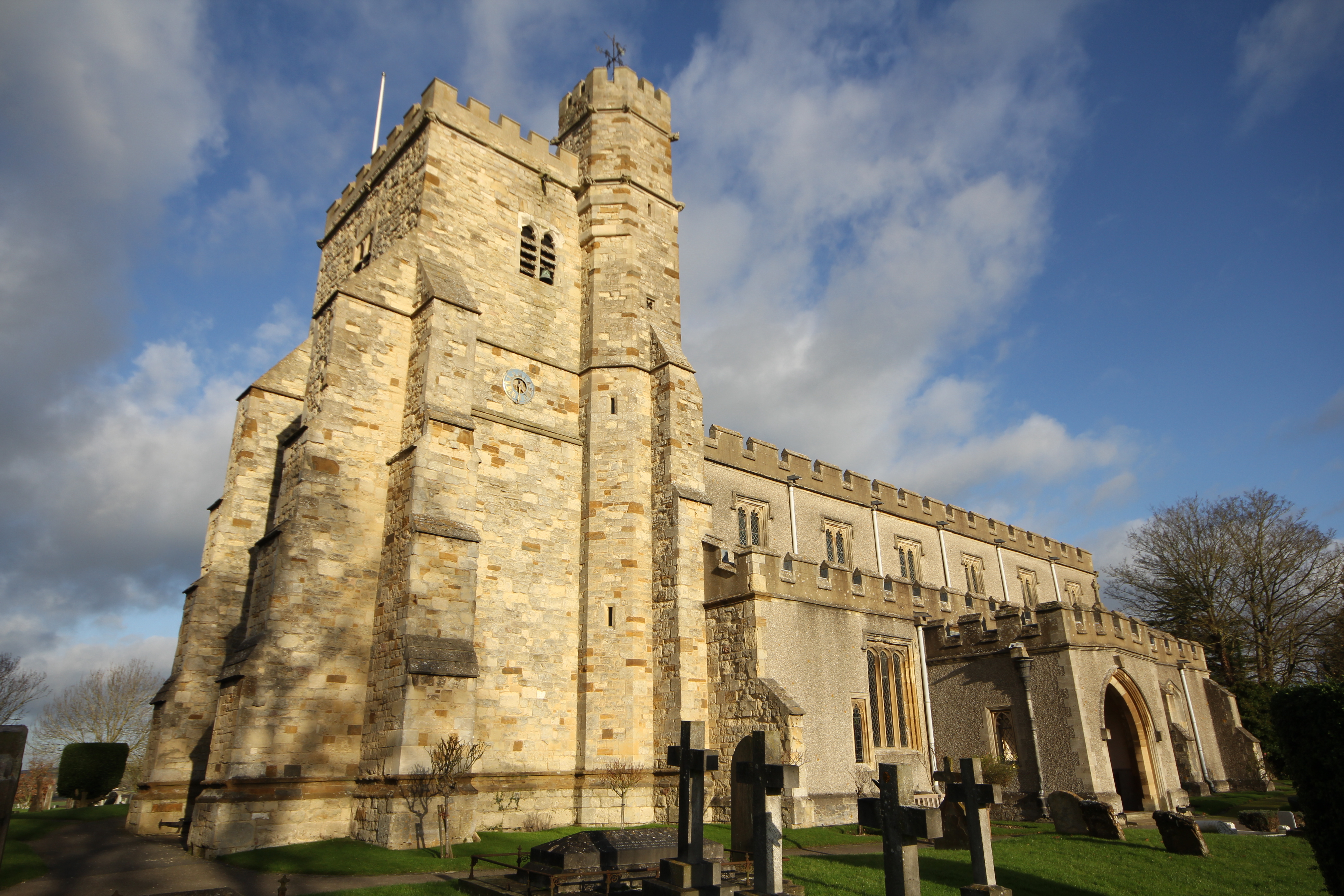
The Grade II* listed church is a spacious and massive structure. It reputedly attained its present size as a “visitation” church able to accommodate the clergy and laity on the occasion of visits of the Bishop of Lincoln and his staff to the Deanery of Waddesdon, before the Diocese of Oxford was created. It is of particular interest to the historian and students of church architecture for it embodies most of the structural developments and Christian symbolism of the English medieval church between the 12th and 15th centuries.
The three middle columns of the south arcade of the nave, and the west respond, which are of the late 12th century, are the earliest details in the building. The nave and the south aisle were lengthened westwards in the 13th century, and early in the 14th century the nave was further lengthened eastward by about 20 ft., entailing the entire rebuilding of the chancel on a new site to the east. A little later, about 1340, the north arcade was formed and the north aisle added to the nave. Towards the end of the 14th century the chancel was widened on the north and a west tower was erected. The chancel was again altered in the latter part of the 15th century, the eastern half of the south wall being rebuilt; at the same time the clerestory was added to the nave, the three eastern bays of the south wall of the south aisle were taken down and widened, and part of the north wall of the north aisle, to the west of the north doorway, appears to have been renewed, probably on account of some structural failure. The south porch, since rebuilt, is also an addition of the same period. In 1862, the nave and chancel were entirely re-roofed. The church has been much restored, the first restoration being completed in 1877; the tower, with the western walls of the aisles, was entirely rebuilt in 1891–2 in coursed rubble stone but retains some old details from the 15th century such as a carved head, gargoyles and the arch to the west door, and the exterior was extensively repaired in 1902. Further restoration work was completed in 1987.
In 2018, the church was placed on Historic England’s Heritage at Risk register because of the poor condition of the floors and the damp in the structure. The latest work, completed in 2019, addressed these issues through the renewal of the external drainage, the replacement of the majority of the rotting, timber suspended floor with a solid stone floor and the installation of a new heating system. At the same time, the pews (which were in poor condition) were replaced by chairs.
Notable internal features are a C15 octagonal font with traceried panels; an elaborate C19 marble pulpit, formerly in the chapel at Blenheim Palace; a carved oak seat with canopy, probably French, early C16; a stone effigy of a knight, c.1330; a brass to Robert Piggott and wife mid C16; a brass to Hugh Bristowe, 1548; a brass to Richard Huntyndon, 1543 with small figure of priest; and a brass to Sir Roger Dynham, knight, 1490, brought from a chantry chapel in Eythrope in 1892.
At one time, the parish of Waddesdon with Westcott and Over Winchendon was reputed to be the second largest in the country in terms of acreage. From early in the 13th century until 1881, the parish was split into three portions, a separate rector being instituted to and receiving a stipend from each portion. A small manor house was attached to each portion. The first mention of this unusual arrangement appears in the Lincoln Diocesan rolls for 1218. The three portions were named Bentham, Motons and Atte Grene or De La Grene. It is not clear how these names came about but Thomas Bentham was a rector (1383-1399) as was Eustace Moton (1318-1361) and Atte Grene may have referred to the location of it’s rector’s house situated in the centre of the village “on the green”. The three portions became a single benefice in 1881. A display board by the south door lists the Rectors of Waddesdon.
In February 1973, an Order in Council combined the united benefice of Over Winchendon and Fleet Marston with Waddesdon to form the current parish. In November 2002, the benefice was dissolved by Order in Council and the parish was transferred to the benefice of Schorne. The Schorne Team comprises twelve churches arranged in nine parishes in the beautiful Aylesbury Vale.
Acknowledgement: To Mr A E Hawkins for the guide to St Michael and All Angels, first published in 1989, from which much of the material here is sourced.

